Get in touch for product inquiries, technical support, or business partnerships regarding polymer additives and specialty chemicals.
Siya Polymer & Speciality Chemicals
Flat No 306 Crown C1 Stella Apartment, Moshi, Pune
Pune, Maharashtra, India – 412105
Siya Polymer & Speciality Chemicals
Rajiv Gandhi Nagar, N2 Cidco
Chh. Sambhajinagar (Aurangabad), Maharashtra, India – 431001
Monday – Sunday: 9:00 AM – 6:00 PM
Learn how polypropylene coupling agents, MAPP compatibilizers, and adhesion promoters improve the performance of polypropylene composites, glass fiber reinforced PP compounds, and mineral-filled polymers.
A coupling agent for polypropylene (PP) is a specialized additive that improves bonding between the polypropylene matrix and reinforcement materials such as glass fibers, talc, calcium carbonate, wood flour, and natural fibers. The most commonly used coupling agent is Maleic Anhydride Grafted Polypropylene (MAPP), which enhances interfacial adhesion and composite performance.
Coupling agents are used in polypropylene composites to improve compatibility between non-polar polypropylene and polar fillers or fibers. Better adhesion results in higher tensile strength, impact resistance, stiffness, dimensional stability, and long-term durability of PP compounds.
Maleic Anhydride Grafted Polypropylene (MAPP) is considered one of the best coupling agents for polypropylene applications. It is widely used in automotive components, glass fiber reinforced polypropylene, talc-filled PP compounds, and natural fiber composites because it significantly improves filler-matrix bonding.
MAPP improves polypropylene properties by creating stronger chemical and physical interactions between polypropylene and fillers. This leads to better dispersion, enhanced mechanical strength, improved impact performance, reduced filler pull-out, and increased overall composite reliability.
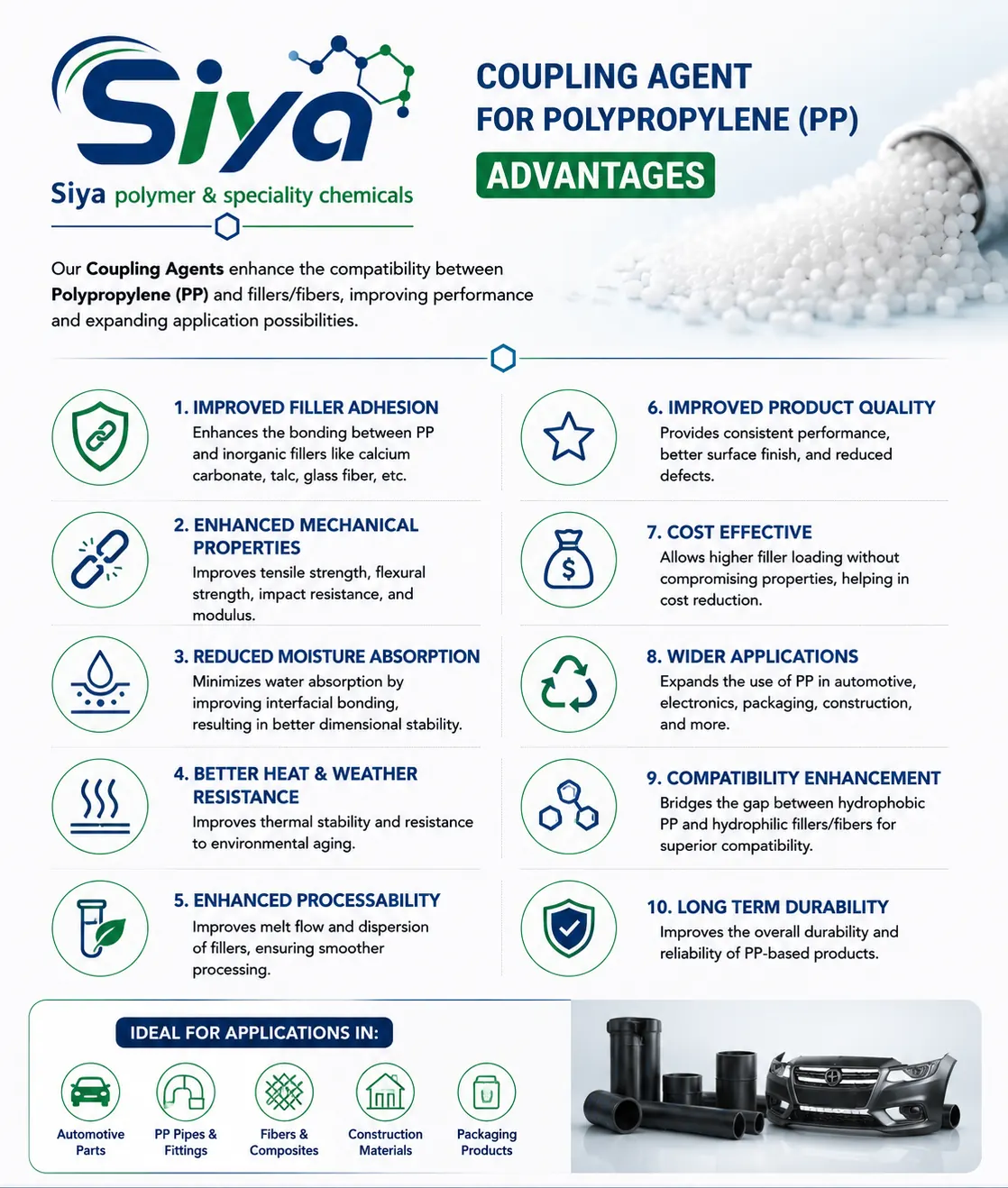
Benefits of coupling agents in polypropylene compounds include improved filler adhesion, increased tensile strength, higher flexural modulus, enhanced impact resistance, better thermal stability, reduced water absorption, and improved processing efficiency during extrusion and injection molding.
Adhesion in polypropylene composites can be improved by using MAPP compatibilizers, optimizing filler surface treatment, selecting suitable processing conditions, and ensuring uniform filler dispersion. These techniques help maximize bonding between the PP matrix and reinforcement materials.
Maleic Anhydride Grafted Polypropylene (MAPP) is a polypropylene-based compatibilizer produced by grafting maleic anhydride onto the PP backbone. It acts as a coupling agent that improves compatibility between polypropylene and polar fillers, resulting in stronger and more durable composite materials.
A polypropylene compatibilizer works by creating a molecular bridge between the polypropylene matrix and incompatible fillers or fibers. This improves interfacial bonding, filler dispersion, mechanical properties, and overall performance of polypropylene composite materials.
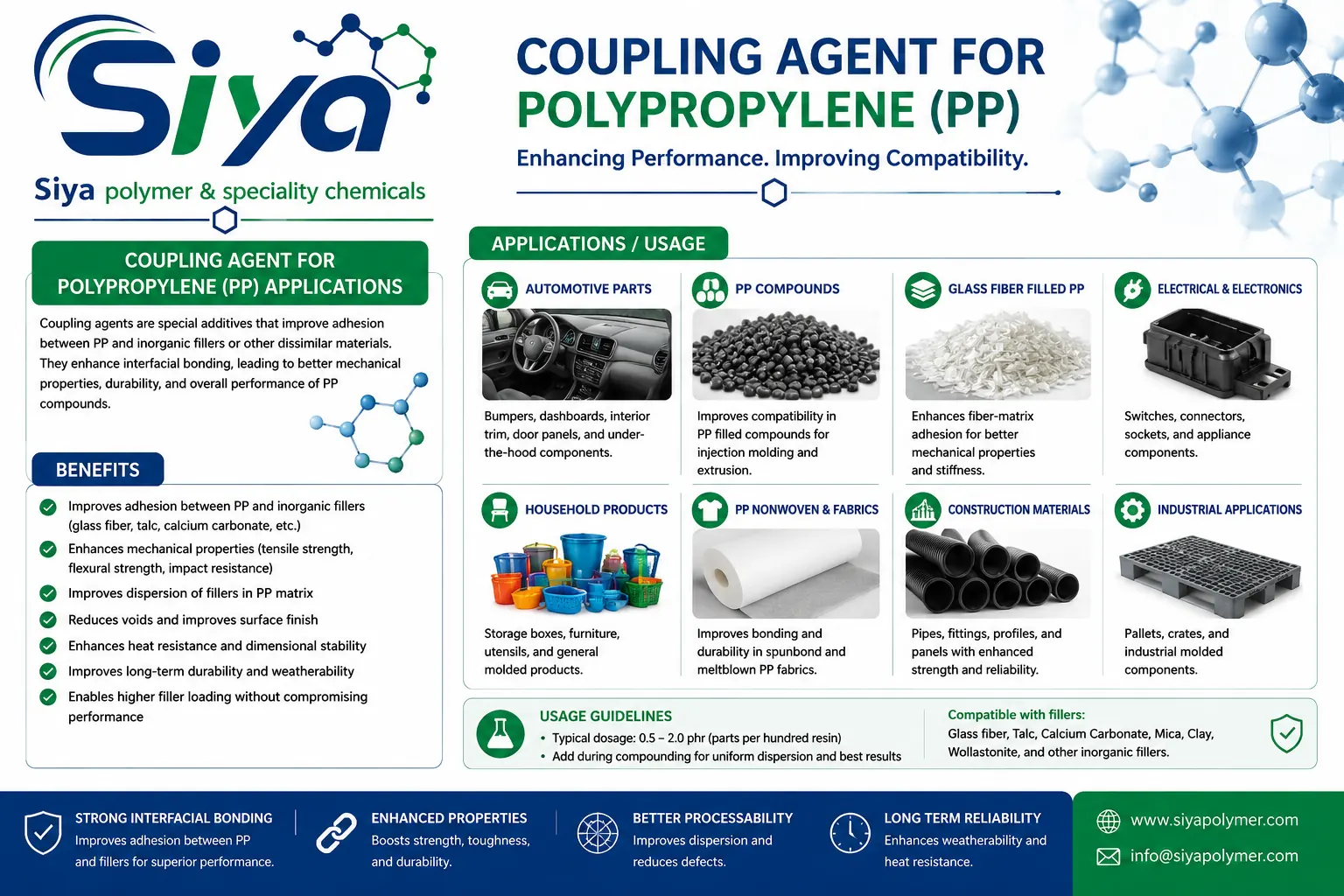
MAPP is commonly used in automotive plastic parts, glass fiber reinforced polypropylene, talc-filled PP compounds, wood plastic composites, natural fiber composites, appliance components, and engineering plastic applications where high strength and durability are required.
In glass fiber reinforced polypropylene, MAPP improves fiber-to-matrix adhesion, leading to higher mechanical strength, better impact resistance, improved stiffness, and enhanced long-term performance in demanding industrial and automotive applications.